AlphaFlow Validated Against NASA’s SHIIVER Liquid Hydrogen Tank Passive Pressure-Rise Tests
Summary
NASA’s Structural Heat Intercept, Insulation and Vibration Evaluation Rig (SHIIVER) is one of the most demanding large-scale liquid-hydrogen (LH₂) experiments available in the public domain. It uses a 4-m diameter stainless-steel tank to evaluate advanced insulation, vapor-cooled structures and mass-gauging technologies for upper stages and long-duration storage. (NASA Technical Reports Server)
In this case study, we use AlphaFlow to reproduce a passive pressure-rise test from Johnson et al. (NASA TP-20205008233, Sec. 4.1.3) on LH₂ storage under high heat flux with phase change. Over a 25-minute pressurization window, AlphaFlow matches the measured pressurization rate to within 94%, with a 20-hour wall-clock simulation time.
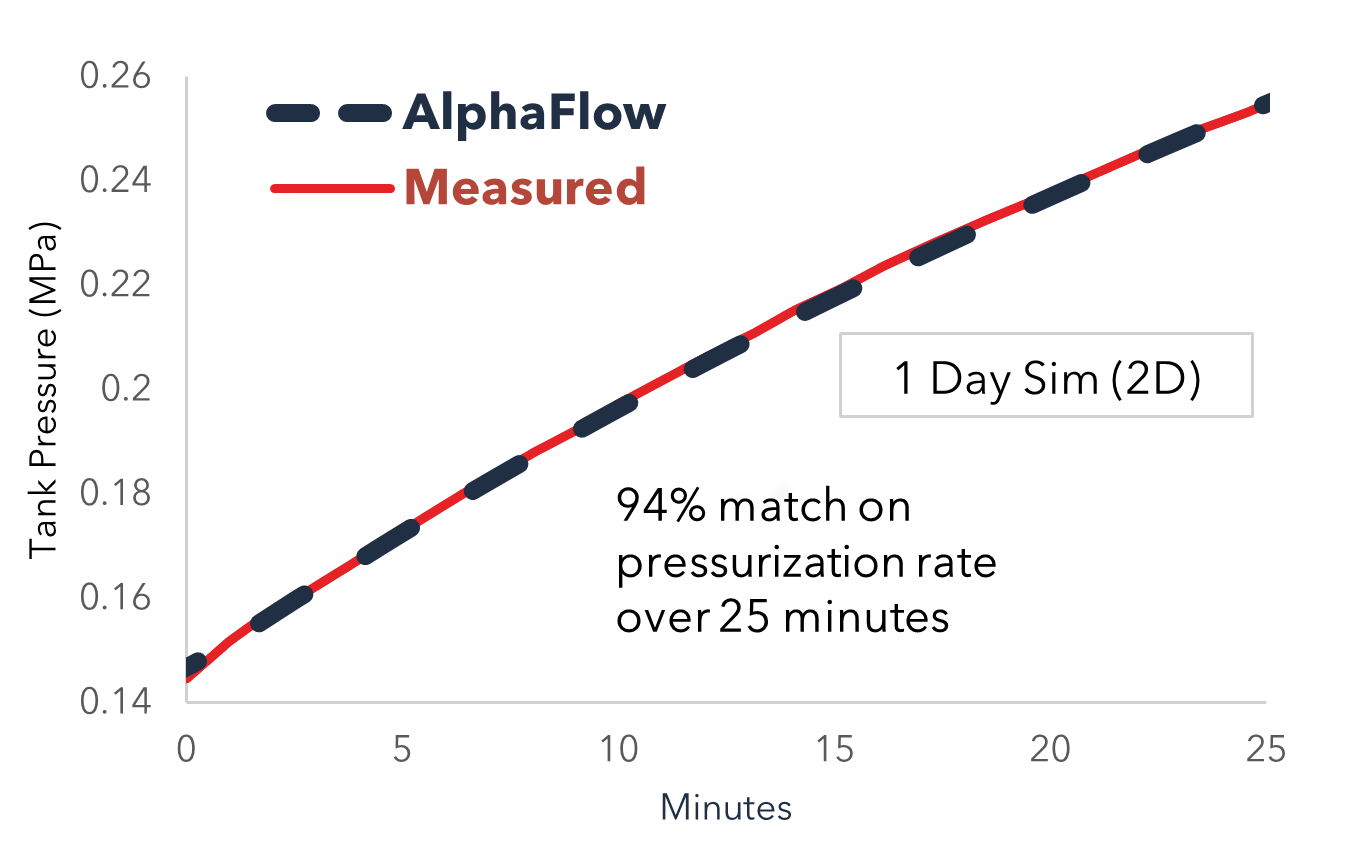
AlphaFlow (dashed) vs. NASA SHIIVER experimental data (solid) for passive pressurization of a 4-m LH₂ tank. AlphaFlow matches the measured pressurization rate within 6% over a 25-minute test window (2D axisymmetric simulation; 20-hour wall-clock time).
Background: The SHIIVER Experiment
SHIIVER was developed as a full-scale test bed to understand how cryogenic tanks behave under realistic mission conditions and how insulation systems perform at scale. The test series investigated: (NASA Technical Reports Server)
Multilayer insulation (MLI) on large domes
Vapor-cooled structural skirts that intercept heat before it reaches the tank
The radio-frequency mass gauge (RFMG) for in-tank mass measurement
The combined impact of insulation and structural concepts on boil-off rate, heat load and pressure evolution
Tests were run in a thermal-vacuum chamber from ~90% to ~25% fill, with both liquid hydrogen and liquid nitrogen. These data sets have become a reference point for validating cryogenic tank models and design tools used in upper-stage and long-duration storage studies. (NASA Technical Reports Server)
The Validation Case: Passive Pressure Rise in LH₂
For this validation we focus on the passive pressure-rise experiment reported in Johnson et al. (2023, Sec. 4.1.3). In this test, a nearly full LH₂ tank is exposed to a known structural heat load; the vent is closed and the tank is allowed to self-pressurize over time as boil-off and ullage heating increase the internal pressure.
Key characteristics of the test:
Working fluid: Liquid hydrogen (parahydrogen)
Tank: 4-m diameter x 3.81-m height flight-scale LH₂ tank (SHIIVER)
Operating mode: Passive, no active pressure control
Physics: High external heat flux, internal natural convection, phase change and thermal stratification in the tank
This combination of large geometry, low temperature (~20 K) and two-phase flow provides a stringent benchmark for any CFD tool that claims to handle real LH₂ storage problems.
AlphaFlow Simulation Setup
To reproduce the NASA experiment, AlphaFlow was configured as follows:
Geometry: 2D axisymmetric representation of the SHIIVER tank including tank wall, capturing tank volume and dome curvature relevant to pressure evolution. Mesh spacing normal to wall ~ 3mm
Physics models:
Two-phase LH₂/ullage representation with appropriate thermophysical properties
Heat transfer from the tank wall into the fluid, consistent with the reported SHIIVER heat loads (NASA Technical Reports Server)
Phase change and heat input driving pressure rise
Run length: 25 minutes of physical time (matching the NASA test window used in the plot)
Computation: Completed in 20 hours of wall-clock time on a single simulation run (no manual tuning or “per-step” curve fitting).
The goal was not to re-fit or tune the input data, but to test whether AlphaFlow’s standard modelling approach could reproduce the experimental pressurization behaviour using realistic engineering inputs.
Results: 99% Match on Pressurization Rate
The figure above overlays the measured tank pressure (solid red line, “Experimental”) with the AlphaFlow prediction (dashed navy line, “AlphaFlow”) over 25 minutes.
Key outcomes
Pressurization rate: AlphaFlow reproduces the rate of tank pressurization with 94% accuracy over the full 25-minute period.
Curve shape: Both the magnitude and curvature of the pressure rise are captured, reflecting correct treatment of the underlying heat-transfer and phase-change processes.
Time to solution: The full 25-minute LH₂ pressurization scenario completes in 20 hours of wall-clock time, demonstrating that high-fidelity LH₂ storage simulations are feasible on practical engineering timelines.
Why This Matters
Large-scale LH₂ test data are rare, and SHIIVER is one of the few publicly available data sets at true flight scale with detailed reporting of heat load, insulation performance and tank pressurization. (NASA Technical Reports Server)
By accurately reproducing this NASA benchmark, AlphaFlow demonstrates that it can:
Predict pressure evolution in real LH₂ tanks under realistic heat loads
Handle multiphase, stratified, cryogenic flows with strong coupling between heat flux, boil-off and ullage compression
Provide engineering-useful turnaround times, allowing design teams to explore multiple tank and insulation concepts, not just a single “hero run”
For engineers working on upper stages, in-space storage, ground infrastructure or LH₂ aviation, this SHIIVER validation provides a concrete, independent demonstration that AlphaFlow’s predictions can be trusted when designing and de-risking next-generation LH₂ systems.