AlphaFlow Accurately Captures Violent Liquid Hydrogen Slosh from Large-Scale NASA K-site Experiment
Summary
NASA’s classic hydrogen slosh campaign at the NASA Lewis Research Center's K-site facility is one of the few large-scale data sets on violent liquid-hydrogen sloshing. Using a 62 ft³ (1.75 m³) spherical tank, NASA ran dozens of tests to understand how strong lateral motion, turbulence and phase change affect tank pressure collapse under normal gravity. NASA Technical Reports Server
In this case study, we use AlphaFlow to reproduce a resonant liquid-hydrogen slosh test from that program. AlphaFlow matches the rapid pressure drop with 98% accuracy over 2.5 minutes of physical time, using a 3D simulation that completes in under two days of compute.
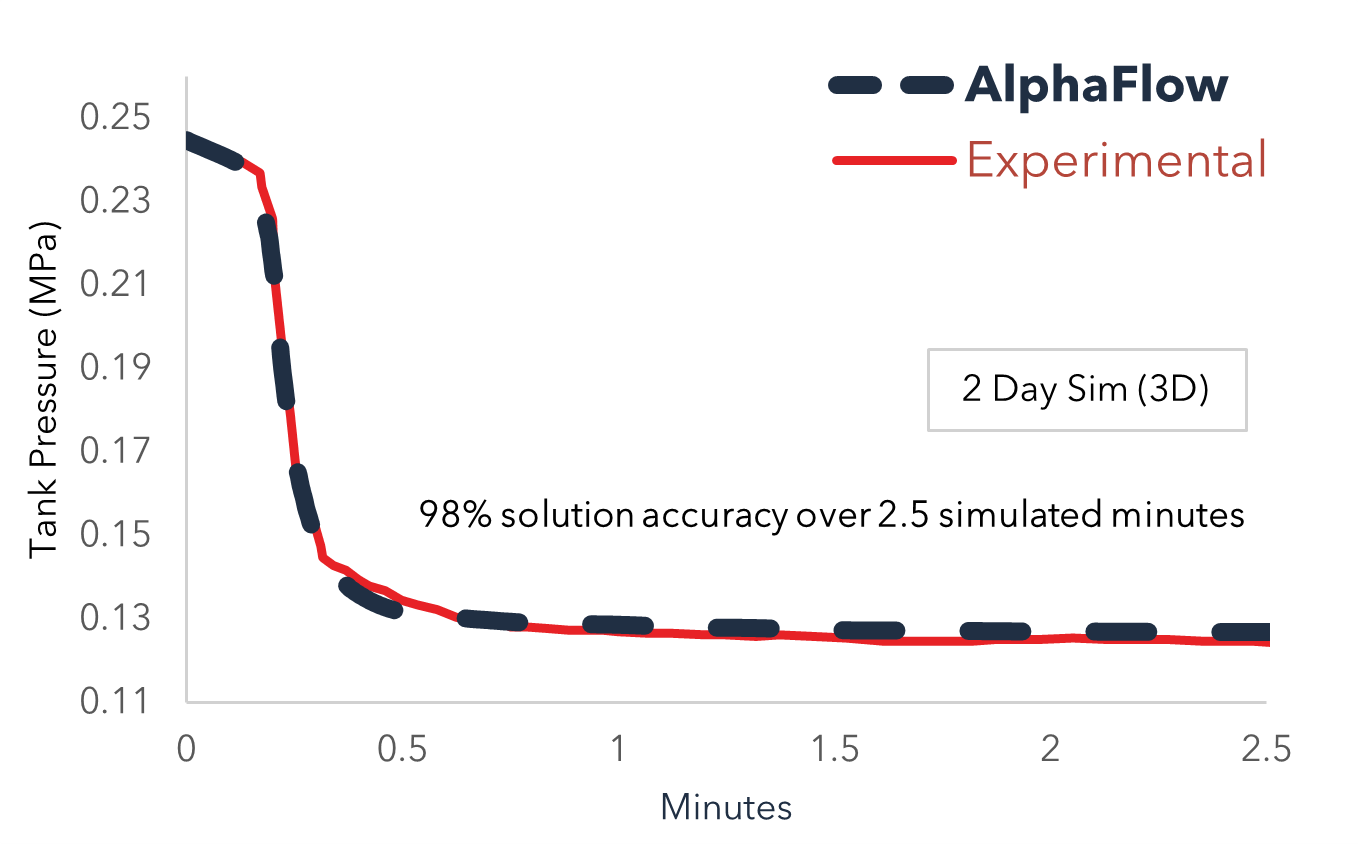
AlphaFlow (dashed) vs. Moran et al. (1994) experimental data (solid) for large-amplitude liquid-hydrogen sloshing in a 62 ft³ spherical tank. AlphaFlow matches the rapid pressure collapse within 2% over 2.5 minutes of sloshing (3D simulation; <2-day runtime).
Background: NASA’s Hydrogen Slosh Program
The test series was developed to support the National Aero-Space Plane (NASP) and future launch vehicles using liquid or slush hydrogen propellants. The goal was to characterize how sloshing affects tank pressure and thermal response.
Key features of the campaign:
Geometry: 62 ft³ (1750 L) spherical tank in NASA Lewis’s K-Site facility
Fluids: Liquid hydrogen and slush hydrogen
Test envelope: Normal gravity, lateral sloshing, with frequency, amplitude, ullage fraction, pressurant type and ramp pressure all varied
These experiments highlighted how slosh can either collapse tank pressure (via heat-transfer) or drive it up (via hot-wall wetting and vigorous boiling) depending on the combination of conditions.
The Validation Case: Rapid Pressure Collapse
For this validation we select one of the closed-tank, liquid-hydrogen resonant slosh tests in which:
The tank is filled with LH₂ and pressurized with gas to a high initial pressure.
Pressurant flow and venting are stopped, locking the tank in a closed condition.
Lateral sloshing is imposed with high amplitude and around 1 Hz frequency, generating intense motion and free-surface deformation.
In this regime, we get rapid mixing of superheated vapor and subcooled liquid, resulting in rapid pressure collapse due to turbulent heat transfer and condensation. The NASA data provide a precise time history of this pressure collapse for a spherical LH₂ tank at realistic scale.
AlphaFlow Simulation Setup
To reproduce this test, AlphaFlow was configured as follows:
Geometry: Full 3D model of the 62 ft³ spherical tank, including ullage and liquid regions. (read-in elements/mesh coarseness)
Motion: Imposed lateral motion matching the NASA shaker conditions (frequency and amplitude chosen to represent the violent-slosh case).
Physics:
Two-phase LH₂/vapour with thermodynamic properties appropriate for the test conditions
Free-surface dynamics, turbulence and wave breaking in the liquid
Run length: 2.5 minutes of physical time (covering the rapid pressure drop and early recovery)
Computation: Completed in less than two days with 105 hours of wall-clock time on a single 3D simulation.
Results: 98% Accuracy on Pressure Drop
The figure below compares tank pressure vs. time for the experiment (solid red line, “Experimental”) and the AlphaFlow prediction (dashed navy line, “AlphaFlow”) over the first 2.5 minutes of sloshing.
Key outcomes
Pressure-drop magnitude: AlphaFlow reproduces the net pressure drop with 98% accuracy, capturing both the depth of the collapse and the subsequent approach toward a new quasi-steady level.
Curve shape: The simulation tracks the steep initial fall in pressure and the later flattening of the curve, indicating that the interplay between slosh-enhanced heat transfer with minimal phase change is correctly captured.
Time to solution: The full 3D run completes in under two days of wall-clock time, making fully resolved, violent-slosh simulations viable within engineering project timelines.
Why This Matters
The slosh campaign is a cornerstone data set for cryogenic propellant management. It is widely cited in later work on cryogenic tanks, slosh-induced pressure variation and CFD validation. (NASA Technical Reports Server)
By accurately reproducing a violent liquid-hydrogen slosh case from this program, AlphaFlow demonstrates that it can:
Handle strongly non-linear free-surface motion, wave breaking and turbulence in cryogenic tanks.
Capture the thermodynamic consequences of slosh—including pressure collapse driven by turbulent heat transfer.
Deliver these predictions at practical turnaround times, supporting design studies for upper stages, high-g manuevers, taxi/take-off scenarios and ground handling where slosh is critical.
For teams designing LH₂ vehicles, stages or storage systems that experience significant motion, this validation shows that AlphaFlow can be trusted to predict how violent slosh will affect tank pressure - with unprecedented speed.